> For the complete documentation index, see [llms.txt](https://helpcenter.xopero.com/xopero-one-en/llms.txt). Markdown versions of documentation pages are available by appending `.md` to page URLs; this page is available as [Markdown](https://helpcenter.xopero.com/xopero-one-en/management/tasks/tasks-details.md).

# Tasks details

## Backup

You can view all task details in the **Tasks** tab of the **Xopero ONE Management Service** (**XMS**) system— click the **info** <img src="/files/EnS0JBrscFF0iFFhTGXL" alt="" data-size="line"> icon next to the selected task to open the details panel.

### <mark style="background-color:blue;">**Summary**</mark>

The summary provides key information about each backup, including the **plan name**, **status**, **end date**, and **duration**. It also shows the **backup type**, **device name**, and details about **transferred data** — divided into **data size** and **retention size** — along with the **total number of transferred files**.

<figure><img src="/files/K4OLfNQ1Ix88i91sKI8U" alt=""><figcaption><p><em>Backup summary example.</em></p></figcaption></figure>

### <mark style="background-color:blue;">Task details</mark>

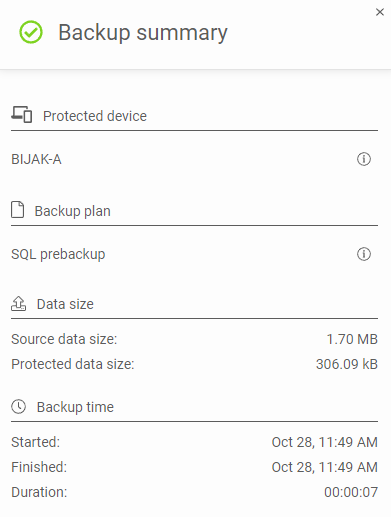
To view more information, click the **Task details** ![](/files/FFfxYhuTjI7GKm9vuUhS) button on the right. A side panel will appear, showing sections for the **protected device**, **backup plan**, **data size**, and **backup time**. You can also see additional details, such as the task’s **start** and **end time**.

<figure><img src="/files/4ZCJGBMMbot4uEhf9pN6" alt="Backup summary in the backup task"><figcaption><p><em>Backup task details panel.</em></p></figcaption></figure>

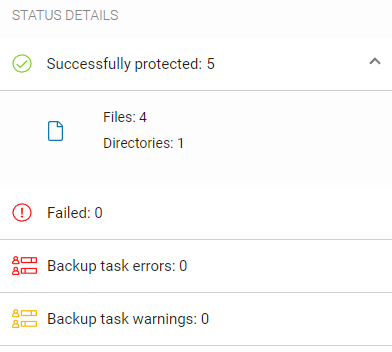
Below, you will find a **status details** section, where you can check the number of directories and files in the <mark style="color:$success;">**successfully protected**</mark>, <mark style="color:$danger;">**failed**</mark>, <mark style="color:$danger;">**errors**</mark>, and <mark style="color:$warning;">**warnings**</mark> sections. A similar view is available for all secured resources.&#x20;

Depending on the type of backup being performed, there may also be sections such as **sent data**, **throttling diagnostics**, or **new resources**.

{% hint style="warning" %}
If any files have been modified, **Xopero** system will indicate how many resources were changed. **Deleted resources**, however, are those removed according to the retention rules defined in the backup plan.
{% endhint %}

<div><figure><img src="/files/D6MDmhzEqDTJEqKnPWLV" alt="Status details in the backup task summary"><figcaption></figcaption></figure> <figure><img src="/files/4BzFnpLLfiRX3vUzaRZ5" alt=""><figcaption></figcaption></figure></div>

***

## Restoration

### <mark style="background-color:blue;">Summary</mark>

Similarly to the backup summary, restoration summary contains information about the **plan name**, **status**, **end date**, and **duration**, as well as details about the **device name**, **restored size**, and **restored sources**.

<figure><img src="/files/MHw32aLkuA14Kh2Vooc4" alt="A row with task information in the Task tab in the Xopero ONE Management Service"><figcaption><p><em>Restoration summary example.</em></p></figcaption></figure>

### <mark style="background-color:blue;">Task details</mark>

To view more information about the restoration task, click the **Task details** ![](/files/FFfxYhuTjI7GKm9vuUhS) button on the right. A side panel will appear, showing sections for the **restore worker**, **type and creation date of backup**, **data source**, **data destination**, **data size**, and **backup time**. You can also see additional details, such as the task’s **start** and **end time**.

<figure><img src="/files/jzXa3WSYxuUrGZran06P" alt=""><figcaption><p><em>Restoration task details panel.</em></p></figcaption></figure>

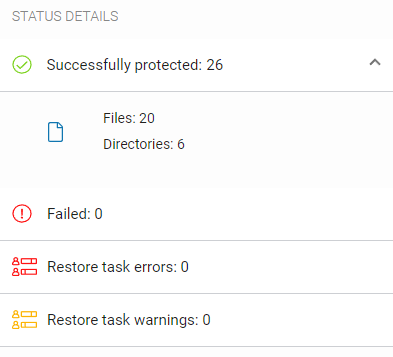
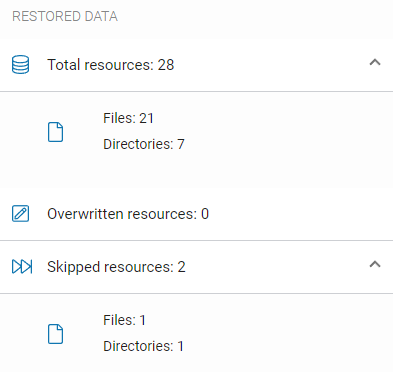
Below, you will find the **details status**, where you can check the number of restored directories and files in the <mark style="color:$success;">**successfully protected**</mark>, <mark style="color:$danger;">**failed**</mark>, <mark style="color:$danger;">**errors**</mark>, and <mark style="color:$warning;">**warnings**</mark> sections. A similar view is available for **all secured resources**, along with additional information about **overwritten data** and **omitted resources**.

<div><figure><img src="/files/CpkWmhYo6D8mzTDLRx9C" alt="Status details in the restore task summary"><figcaption></figcaption></figure> <figure><img src="/files/9PtHvf0kdDqPtqj6DDTB" alt="Restored data in the restore task summary"><figcaption></figcaption></figure></div>

***

## Replication

### <mark style="background-color:blue;">Summary</mark>

The replication summary contains information about the **replication plan name**, **status**, **end date**, and **duration**, as well as details about the **device name**, **source storage**, and **target storage**.

<figure><img src="/files/apM36lLXV58ao79yBrtk" alt="A row with task information in the Task tab in the Xopero ONE Management Service"><figcaption><p><em>Replication summary example.</em></p></figcaption></figure>

### <mark style="background-color:blue;">Task details</mark>

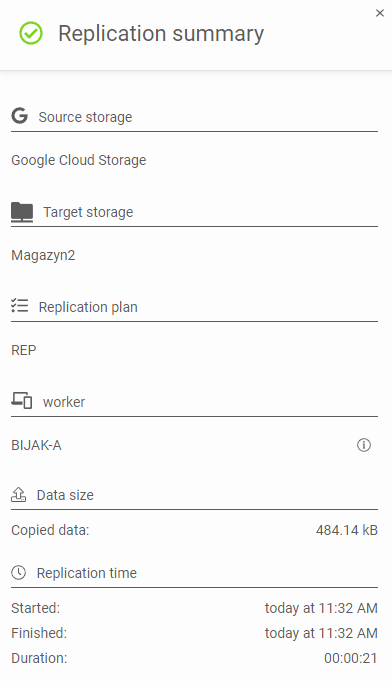
To view more information about the restoration task, click the **Task details** ![](/files/FFfxYhuTjI7GKm9vuUhS) button on the right. A side panel will appear, displaying the following sections: **source storage**, **target storage**, **replication plan**, **worker**, **data size**, and **replication time**.

<figure><img src="/files/o0tMkZRQN08U99qtthUk" alt="Replication summary in the replication task"><figcaption><p><em>Replication task details panel.</em></p></figcaption></figure>

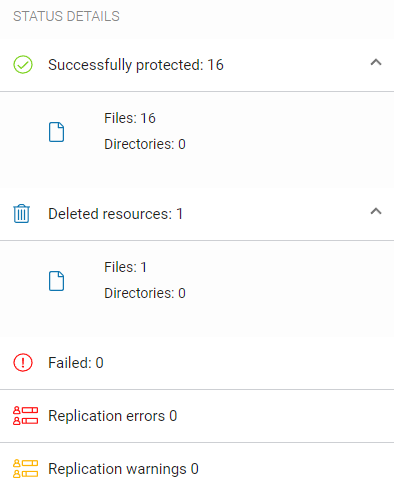
Below, same as for backup and restoration, you will find the **status details** section, where you can check the **number of replication directories and files** in the <mark style="color:$success;">**successfully protected**</mark>, <mark style="color:$danger;">**failed**</mark>, <mark style="color:$danger;">**errors**</mark>, and <mark style="color:$warning;">**warnings**</mark> sections.

<figure><img src="/files/IfV2wm4IztytS4eZ7DFL" alt="Status details in the replication task summary"><figcaption></figcaption></figure>