> For the complete documentation index, see [llms.txt](https://helpcenter.xopero.com/xopero-one-en/llms.txt). Markdown versions of documentation pages are available by appending `.md` to page URLs; this page is available as [Markdown](https://helpcenter.xopero.com/xopero-one-en/management/logs.md).
# Logs
In this article, you will get information about logs tab and logs archiving in Xopero ONE Management Service.
#### Logs in **Xopero ONE Management Service** provide detailed records of backup activities, system operations, and events.
***
## General information
The **Logs** tab in **Xopero ONE Management Service** provides information about every event occurring in **Xopero ONE** backup system (i.e., logging in to [**XMS**](#user-content-fn-1)[^1], backup task status, etc.).
The system relies on lightweight, high-performance databases to efficiently handle and store data. From the moment the service is activated, every log entry is recorded and preserved, ensuring a complete and continuous history of system activity.
{% hint style="danger" %}
Please note that excessive generation of log entries may affect the performance and stability of the log database.
{% endhint %}
Archiving older logs helps maintain system efficiency. **Xopero ONE** includes a log archiving feature that keeps archived logs fully accessible and searchable.
***
## Logs archiving
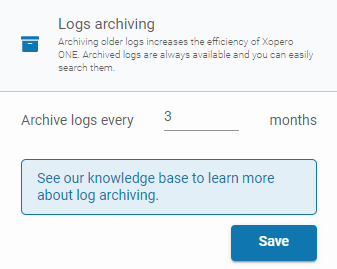
To configure log archiving, click the ⚙️ **Settings** icon at the bottom of the left-hand menu, then select **Advanced** > **Logs archiving** to expand the options:
1. **Archive logs every** – specify the number of months after which the system should archive older log entries. By default, the system archives logs **every 3 months** and retains logs for the entire current month.
***
## Logs tab
In **Logs** tab you can view all log entries — you can filter them by date, event subject, trigger, or subject name. The top bar displays the date from which logs are available (**Date from**).
To view logs from a different time period, click the **magnifying glass 🔍** icon on the right. In the [advanced search window](#advanced-search-engine), use the **DATE FROM** and **DATE TO** filters to display logs from a specific time period.
{% hint style="info" %}
To view all logs, click the **X** button next to **Reset All** or **Date from**—the system will then load all available logs.
{% endhint %}
***
## Logs table
#### The logs table contains the following entries:
1. **LEVEL** — indicates the status of an event. **Xopero ONE** defines four types of event status:
1. **Success** — confirms the successful completion of a task.
2. **Info**** —** provides informational messages, such as changes in backup plans.
3. **Warning** — indicates conditions that may conflict with intended actions or partial errors that could result in data loss within backup plans.
4. **Error** — reports critical errors.
2. **LOG** — name of the event.
3. **DATE** — timestamp of when the event occurred.
4. **SUBJECT OF EVENT** — target of the action or operation.
5. **NAME OF SUBJECT** — name of the target.
6. **TRIGGER** — element responsible for initiating an operation by sending the request. For example, if a backup plan is started manually by the administrator, the trigger is the administrator account. If the backup plan starts automatically based on the defined schedule, the trigger is the schedule.
{% hint style="success" %}
You can also manage the displayed columns — click the **gear** ⚙️ icon to open a list of elements that can be shown in the log entries table.
{% endhint %}
Logs table in Xopero ONE Management Service (XMS).
***
## Log details
To view detailed information about a log entry, click the **log details** ℹ️ icon next to the selected entry.
Click **Show more** at the bottom of **Log details** panel, and then **log details** ℹ️ icon next to the selected entry to view additional information such as device name, backup plan, data size, timestamps, status details, and sent data.
***
## Advanced search engine
To view logs from a different time period or filter them by trigger, organization, device, or event status, click the **magnifying glass 🔍** icon on the right to open the advanced search window.
You can search for an event(s) by name or apply one of the following filters:
1. **LEVEL** (select one of the available event statuses: **Info**, **Warning**, **Error** and **Success**)
2. **DATE FROM**
3. **DATE TO**
4. **SUBJECT OF EVENT** (i.e., device, user, plan, task, group, organization, virtual machine, server, etc.)
5. **NAME OF SUBJECT**
6. **TRIGGERED BY** (trigger for the system or scheduled task)
{% hint style="success" %}
You can save configured filters by clicking the **Save** button.
{% endhint %}
[^1]: Xopero ONE Management Service