> For the complete documentation index, see [llms.txt](https://helpcenter.xopero.com/xopero-one-en/llms.txt). Markdown versions of documentation pages are available by appending `.md` to page URLs; this page is available as [Markdown](https://helpcenter.xopero.com/xopero-one-en/deployment-and-configuration/xopero-one-agent/agent-configuration.md).
# Agent configuration
## Activation (license assignment)
{% stepper %}
{% step %}
Login to your **Xopero ONE Management Service** (**XMS**) console.
{% endstep %}
{% step %}
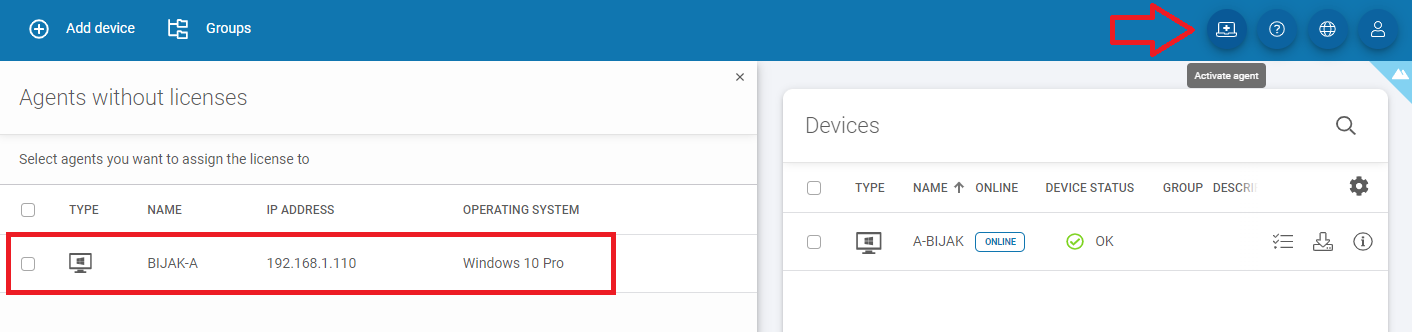
Click the **Activate agent** icon in the top menu.
{% endstep %}
{% step %}
A sidebar will appear, showing a list of available agents — you can view basic details like device type, name, IP address, and operating system.
{% endstep %}
{% step %}
Select the device you want to activate (you can select multiple devices if you assign them the same license type) and press the **Activate** button to proceed.
{% endstep %}
{% step %}
Next, select the license type you want to assign to the chosen device(s) and click **Assign license** to confirm your selection.
{% endstep %}
{% step %}
Once the license is correctly assigned, your device(s) will be visible in the **Devices** tab.
{% endstep %}
{% endstepper %}
{% hint style="info" %}
In the **Xopero ONE** system, the local worker, cloud worker, and feature worker licenses are **free**. These licenses allow specific operations, except for backing up the device itself — thus, devices with these licenses appear under **Settings** > **Advanced** > **Workers** tab.
{% endhint %}
***
## Configuration
{% hint style="danger" %}
To modify the `config.json` file, **you must stop** the **Xopero ONE Backup\&Recovery Agent** service. After making your changes, restart the service (you might also need to refresh the changes in the **Management Service** panel).
{% endhint %}
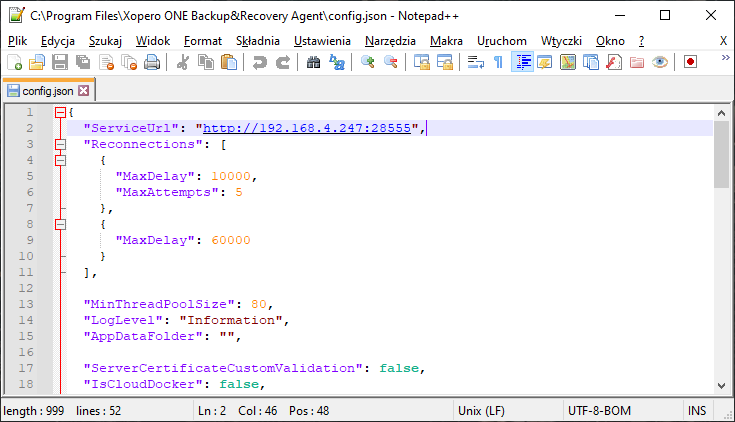
The `config.json` file, by default, is located in the following locations:
1. For **Windows**: `C:\Program Files\Xopero ONE Backup&Recovery Agent`
2. For **Linux**: `/opt/XoperoONEBackupAgent/`
💡You can edit `config.json` with a simple text editor (i.e., **Notepad++**).
### Management Service address
The **Xopero ONE** **Management Service** (**XMS**) address to which your agent connects is crucial during both installation and configuration. If the IP address or protocol (http/https) of the **Management Service** changes, the agent's status will switch to offline. To re-establish the connection, update the `ServiceUrl` value in the configuration file with the updated address.
***
### Log level
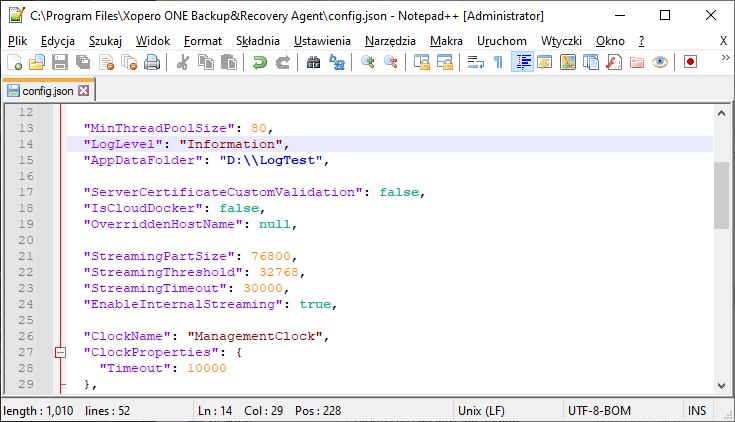
By default, the `LogLevel` value is set to `Information`. You can change it to:
1. `Trace`
2. `Debug`
3. `Information`
4. `Warning`
5. `Error`
6. `Critical`
7. `None`
***
### Default log path
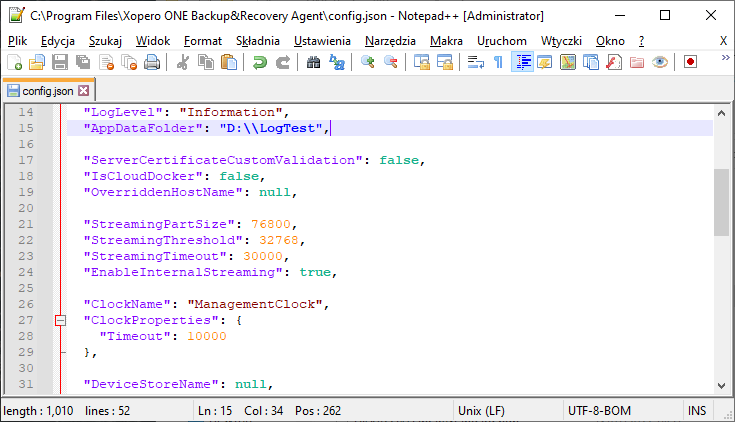
By default, application logs are stored in the following directory: `C:\ProgramData\Xopero ONE\Xopero ONE Backup&Recovery Agent\Logs`. To change the location, modify the `AppDataFolder` parameter.
{% hint style="warning" %}
Please note that the correct `AppDataFolder` value format includes **double slash** after the drive letter (i.e., `D:\\`).
{% endhint %}
***
### Device name
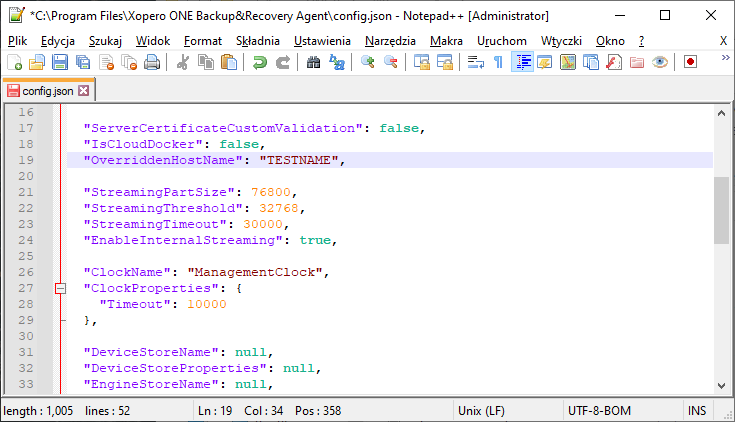
The device name defaults to the system's name. To customize it, modify the `OverriddenHostName` parameter.
{% hint style="warning" %}
Please note that the custom name must be in entered with quotation marks (i.e., `"TESTNAME"`).
{% endhint %}
***
### Number of retries
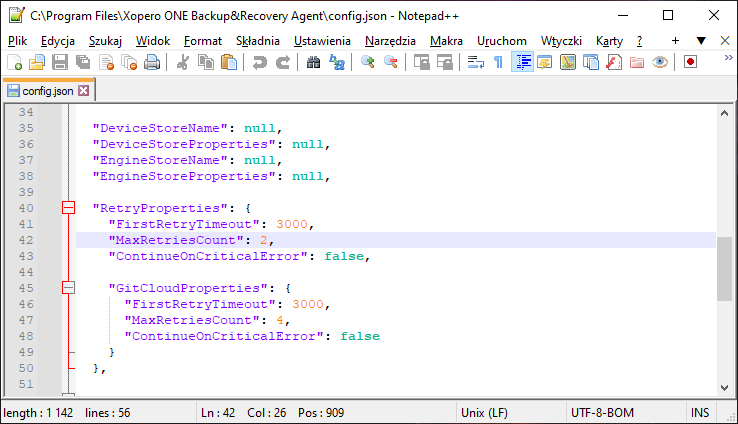
If database backup task ends with error **DV0249 - "Unable to read backup data"**, first address any connection stability issues on your end. If the problem persists, you can increase the retry attempts in the **Xopero ONE** application— to do this, simply edit the `MaxRetriesCount` parameter, changing its default value from **2** to a higher value, i.e., **20**.
***
### Virtual appliance
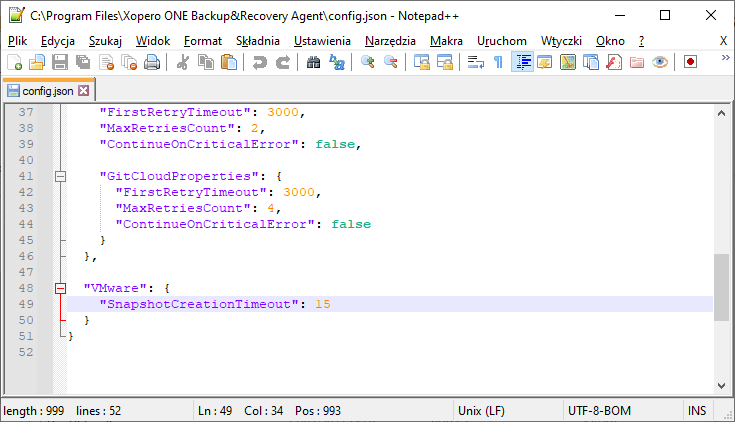
The **VMware** virtual appliance is a **Linux**-based machine with an agent service. You can modify its settings by editing the `config.json` file.
To configure the timeout for snapshot creation, locate the **VMware** section at the bottom of the file and adjust the `SnapshotCreationTimeout` parameter to your needs.